Comparing real-estate areas with H3 cells
How H3 cells support structured area comparison for agents, valuers, investors, and public organisations.
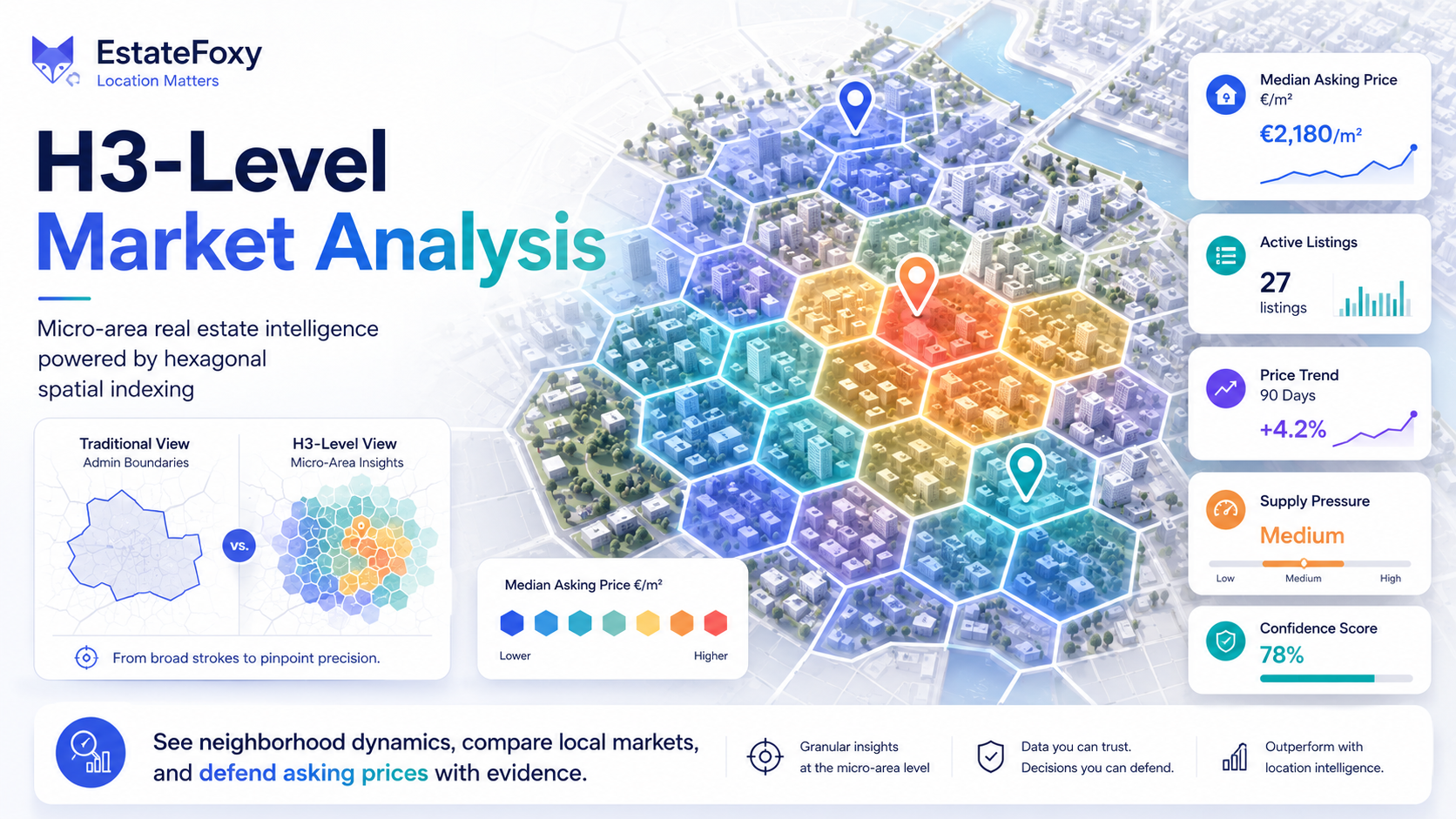
Comparing real-estate areas with H3 cells
Real-estate decisions often involve comparison. Is this area more active than another? Does one micro-area have stronger amenities? Is another area more exposed to risk? Which location has better evidence for a specific use case?
H3 cells make these questions easier to structure.
Why compare cells?
Traditional area labels can be vague. A neighbourhood name may cover many different conditions. One side of an area can have different access, terrain, services, or market activity than another.
H3 cells create smaller, consistent units for comparison. Each cell can hold the same categories of evidence, making side-by-side analysis clearer.

What can be compared?
At H3 level, area comparison can include indicators such as:
- market activity
- price level context
- trend evidence
- amenity richness
- distance to sea
- demographic context
- terrain and land cover
- risk indicators
- confidence and data coverage
The comparison does not need to produce a single winner. Often the best result is a clearer explanation of strengths, weaknesses, and uncertainty.

For agents
Agents can use H3 comparison to explain local differences to clients. Instead of relying only on broad statements, they can point to structured evidence about nearby micro-areas.
This can support conversations about positioning, demand context, and local advantages.
For valuers
Valuers can use H3 comparison as supporting context. It can help describe area conditions and identify where evidence is stronger or weaker.
It should not replace professional valuation judgement or comparable analysis. It is an additional area-level evidence layer.
For investors and public organisations
Investors can use H3 cells to screen areas and compare local conditions before deeper due diligence. Public organisations can use consistent cells to understand spatial patterns across municipalities or regions.
In both cases, the strength is repeatability. The same evidence categories can be reviewed across many cells.
Careful interpretation
Area comparison should use careful language. H3 cells can show indicators, evidence, confidence, trends, and micro-area context.
They should not be used to claim exact outcomes for individual properties. Their value is in making location evidence easier to compare and explain.