EstateFoxy as a business app: From Greek market data to defensible real-estate decisions
A structured explanation of EstateFoxy's business logic, users, workflows, and evidence model.

EstateFoxy as a business app: From Greek market data to defensible real-estate decisions
EstateFoxy is built around a practical problem in real-estate work: professionals are asked to explain local value, opportunity, risk, and confidence, but the raw evidence is scattered across maps, portals, spreadsheets, public data, local knowledge, and repeated manual judgement. A single listing can be interesting, but it does not explain the area. A municipality can be useful, but it is often too large. EstateFoxy sits between those extremes by turning Greece into comparable H3 micro-markets and giving each area a structured evidence profile.
The application is not designed as another listings portal. Its logic is closer to a real-estate intelligence operating system. Users start from a map, inspect market and location layers, select a cell or group of cells, understand the evidence behind the location, and produce reports that can be shared with clients or used internally. The value is not only the data itself. The value is that the same evidence model supports exploration, comparison, reporting, subscriptions, administration, and operational data collection.
Who the app is built for
EstateFoxy serves several professional groups that all need local market explanations but use them differently.
Real-estate agents need fast area context when advising sellers, buyers, landlords, or investors. They need to understand whether a price looks consistent with the local micro-market, whether the area has enough active evidence, and which features are likely to matter in client conversations.
Valuers need a more careful chain of reasoning. They need to document market level, comparable context, price movement, confidence, and limitations. EstateFoxy helps by making the source area explicit and by separating strong evidence from pending or unavailable evidence.
Investors and developers need to compare opportunities across locations. They care about price level, trend, activity, amenities, terrain, distance to sea, environmental context, risk, and whether a location has relative value compared with nearby alternatives.
Agencies and teams need repeatable workflows. A team cannot rely on each person's private spreadsheet or memory. EstateFoxy gives teams shared map logic, shared reporting, shared templates, shared user management, and controlled quotas.
Public organisations and larger partners may use the same evidence model to understand local market pressure, development zones, amenities, land-cover context, or regional trends.
The main workflow
The product workflow follows a simple path:
- Open the market map and choose the current market mode.
- Inspect H3 micro-market cells and visible evidence layers.
- Select one or more H3 cells.
- Read the Market Insight panel for that area.
- Compare price, amenities, trends, listing details, and environmental context.
- Generate an area report or valuation report.
- Track jobs, exports, and historical report output.
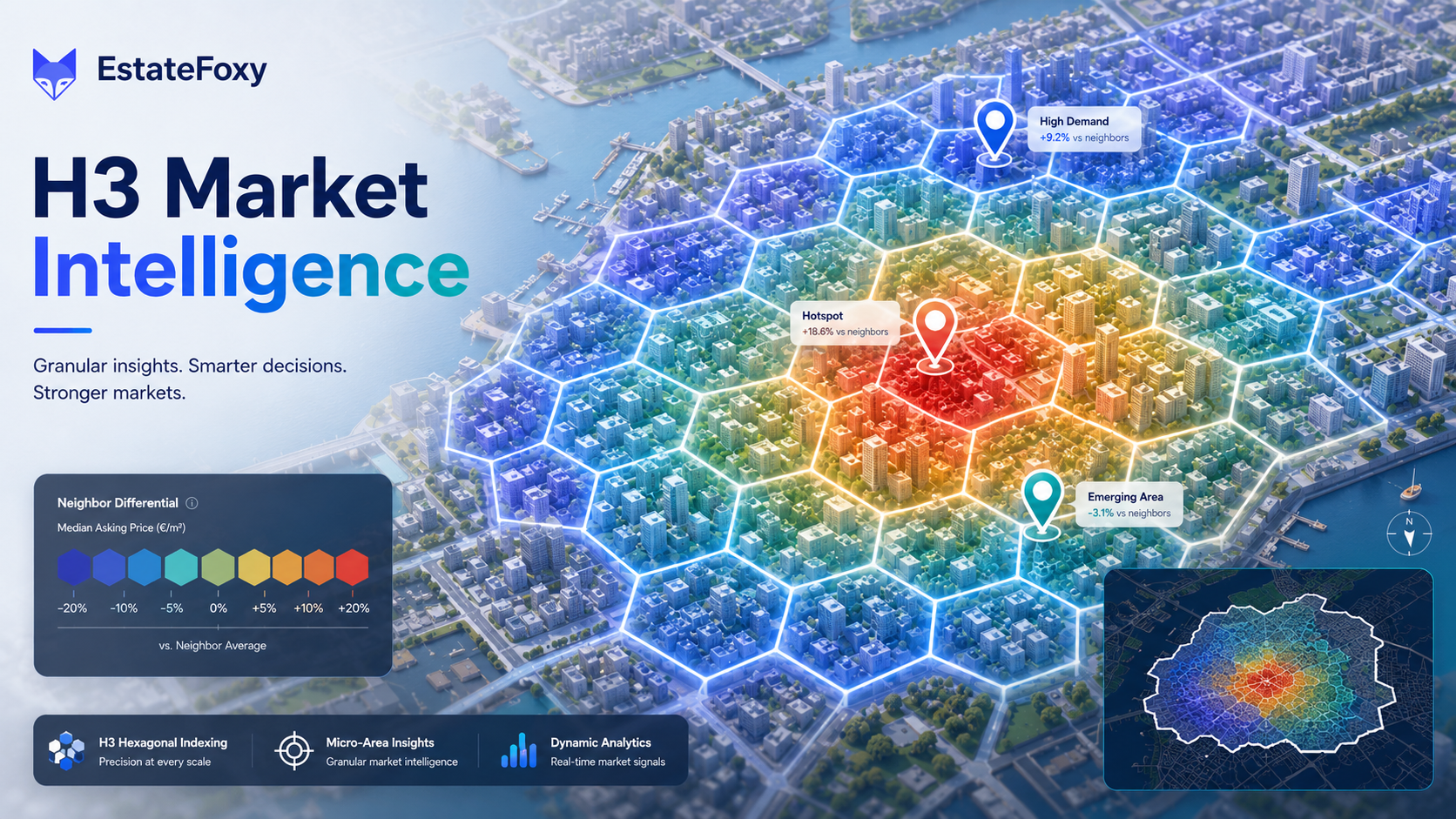
This matters because real-estate advice usually fails when the boundary of analysis is vague. A professional might say "this neighbourhood is strong" or "prices are rising here", but the client may not know which exact area is being discussed. H3 cells solve that by giving the app a repeatable spatial unit. Every selected area is explicit.
Why H3 cells are central
EstateFoxy uses H3 cells because real-estate decisions are spatial but need consistent units. A city block may be too detailed. A municipality may be too broad. A listing point may be too individual. H3 cells give the app a middle layer: small enough to feel local, consistent enough to compare, and structured enough to aggregate market data.
In the product, an H3 cell is not just a shape on the map. It is the container for market evidence. It can hold active listing counts, average asking price, EUR per square metre, trend signals, amenity counts, demographic indicators, terrain metrics, distance-to-sea information, land-cover summaries, risk context, and confidence metadata.
The result is a repeatable business object: the micro-market. When EstateFoxy reports on a location, it is not inventing a new area each time. It is using the same spatial model across map, reports, filters, admin readiness, and export workflows.
What makes the logic defensible
EstateFoxy does not treat all evidence as equal. The platform separates available evidence from pending or unavailable evidence. That distinction is important for professional use. If demographics are missing, the app should not show zero and imply that nobody lives there. If listings are sparse, the report should show lower confidence rather than pretending the estimate is precise.
The application also keeps heavy data preparation outside normal browser requests. Market layers, H3 foundations, enrichment, listing aggregation, and report artifacts are prepared through backend services and offline jobs. The browser reads serving data. This keeps the app responsive and makes the evidence more stable.
How the business app is organised
EstateFoxy has several connected surfaces:
- The public landing page explains the product and sign-in path.
- The authenticated map is the main market workspace.
- Market tools include advanced filters and prospecting radar.
- Report tools include valuation reports, area reports, background jobs, and downloads.
- Admin tools include users, subscriptions, quotas, DATA operations, scraper stats, report template preparation, and operational readiness.
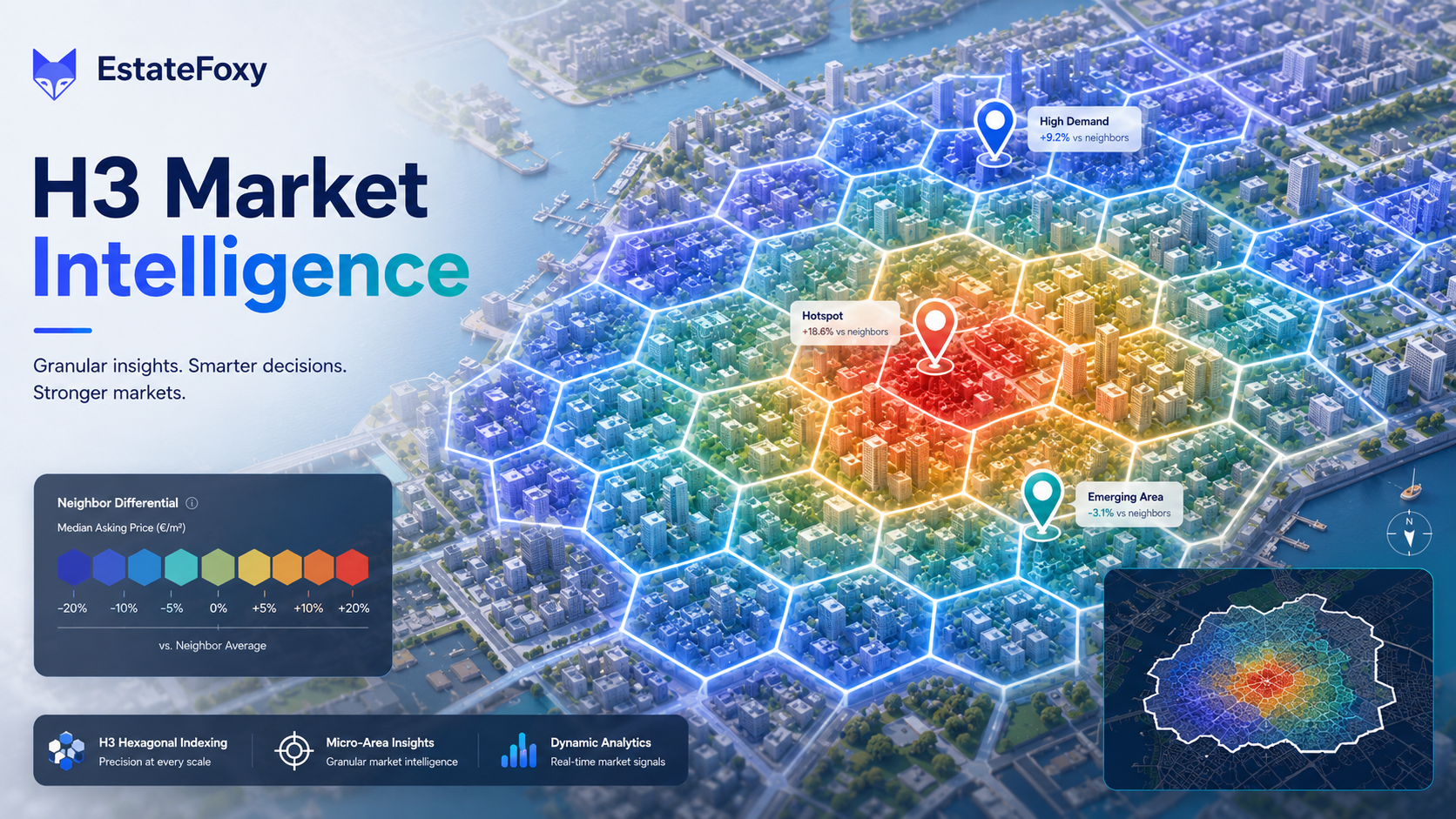
This structure is deliberate. The product is not only a beautiful map. It is a business workflow: data enters the system, evidence is served to users, users create insight, teams control access, and reports turn analysis into a client-ready artifact.
The commercial logic
The subscription model is based on usage value. Users pay for access to market intelligence, report capacity, exports, and team features. Administrators manage users, roles, subscription state, quotas, and report templates. This is important because the app is not a one-time PDF generator. It is a recurring workspace for repeated market decisions.
Different users need different access levels. Admins manage the organisation. Clients use the platform for market and report workflows. Scrapers support data collection and operational updates. By keeping these roles separate, EstateFoxy protects sensitive admin functions while still allowing teams to work efficiently.
Practical takeaway
EstateFoxy turns local real-estate judgement into a structured application workflow. The app combines map exploration, H3 micro-markets, data layers, reporting, access control, and operations into one product. The business logic is simple: make the area explicit, make the evidence readable, make confidence visible, and make the output repeatable.