What is an H3 cell in real estate analytics?
A simple explanation of how H3 cells help aggregate property points into comparable micro-area evidence.

What is an H3 cell in real estate analytics?
An H3 cell is a small hexagonal area on the map. Instead of looking at every property point one by one, H3 lets an analytics system group nearby points into a consistent spatial unit.
For real-estate analysis, this is useful because individual points can be noisy. A single listing, building, or transaction may reflect a specific property condition, negotiation, or temporary market event. A cell helps shift the discussion toward the surrounding micro-area.
From points to cells
Real-estate data often starts as points:
- listing locations
- points of interest
- transport stops
- schools, services, and amenities
- environmental or risk observations
H3 places these points into hexagonal cells. The platform can then count, summarize, and compare evidence inside each cell.
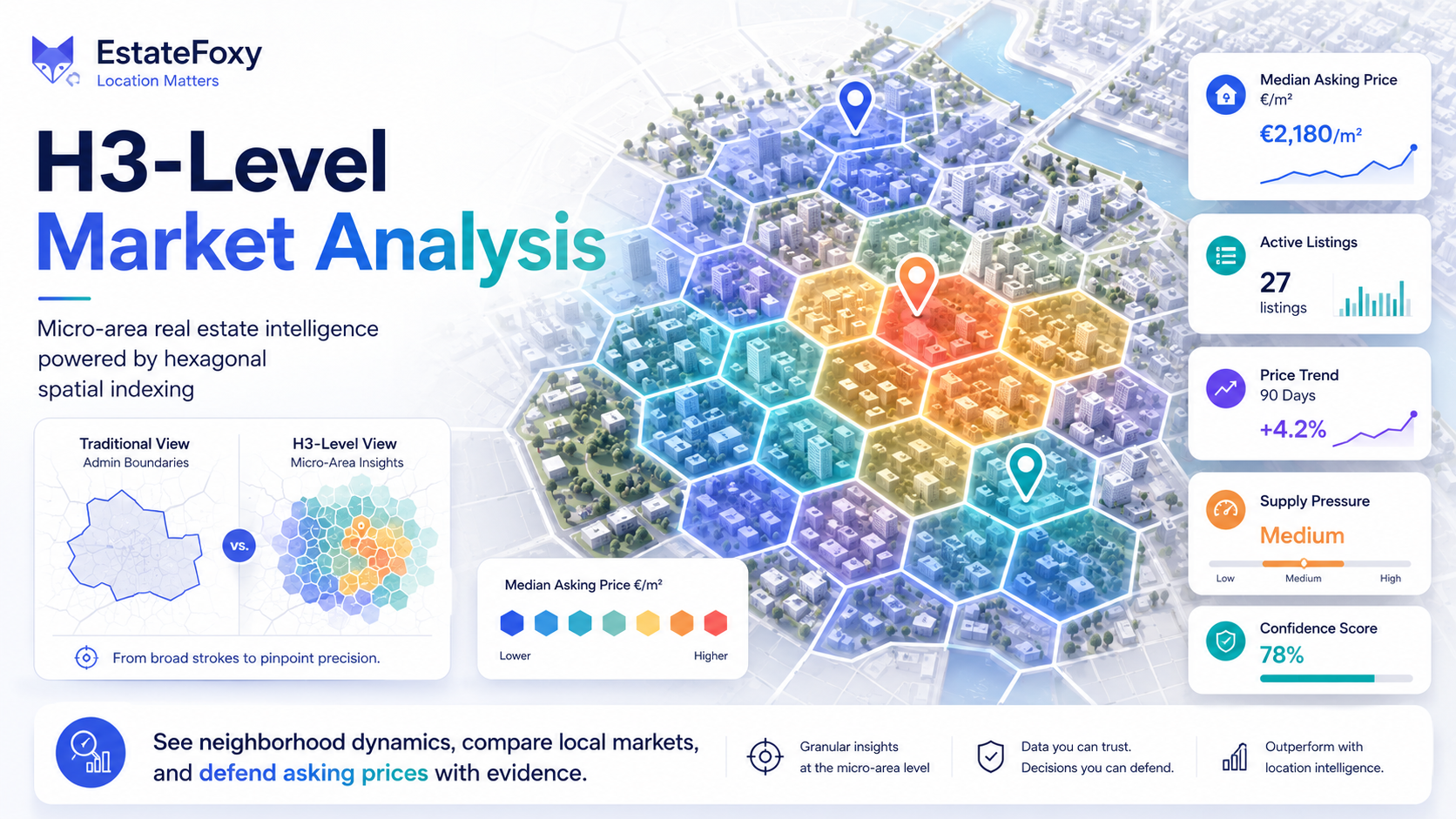
For example, a cell can become a compact way to describe local context:
- how much market activity exists nearby
- which amenities are present
- whether evidence is recent or limited
- how the area compares with nearby cells
Why use cells instead of only addresses?
Addresses and individual listings are too specific for many market questions. A buyer, agent, valuer, investor, or public organisation often needs to understand the local area around a property, not only the property itself.
An H3 cell becomes a repeatable micro-area analysis unit. Each cell has the same kind of shape, a stable identifier, and a clear position on the map. This makes it easier to compare one area with another.
What a cell can and cannot say
An H3 cell can support careful area-level interpretation. It can help show indicators, trends, evidence strength, and micro-area context.
It should not be treated as an exact valuation for any individual property. Property-specific decisions still need professional judgement, comparable review, building condition, legal checks, and local knowledge.
The useful role of H3 is to make location evidence easier to organise, compare, and explain.